“…in these dusty sheaves of paper, are regular accounts of Africa’s global interactions from the very distant past; and yet the traditional Western narrative is of Africa’s ahistoricity.”
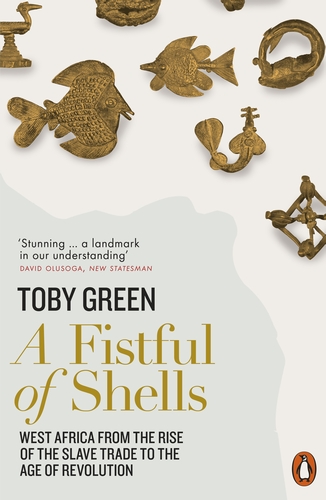
The next time you find yourself on a coastline admiring seashells by the seashore you may come across a cowrie shell. Did you know however that cowries functioned both as a major currency in West Africa and as a valued religious item filling the Ile Ori shrines of Yoruba households? Were you aware that medieval kingdoms of West Africa like Kongo, Benin and Dahomey sent and received ambassadors from Portugal, Amsterdam and Spain? And when you think of wealth don’t think Bezos or Musk, think Mansa Musa the Malian Emperor who’s stewarding of the Saharan gold trade made him the richest man who has ever lived.
These are but a few of the fascinating snippets of African history that Toby Green weaves into his groundbreaking history of West Africa. A Fistful of Shells not only brings together the best of African historiography into an accessible and engaging narrative but dispels a great many myths concerning the continent. You might find it shocking that the enlightenment philosopher G. W. F. Hegel believed Africa to be, “no historical part of the world.” Yet most of us since Hegel’s time, both scholars and laymen, have blindly accepted this ahistoric rendering of Africa. A Fistful of Shells hammers an authoritative nail in the coffin for the Hegelian notion.
Green certainly lives up to his nickname, the ‘Braudel of West Africa’, as he exudes intellectual courage in spades. His analyses of revolutionary Islamic movements, the rise of the ‘fiscal-military state’ and the overthrowing of aristocracies by merchant classes provide Green with a firm footing to assert that African history stands as a constituent part of World History. We see time and again that West Africa had deeply rooted relationships of trade and diplomacy with the rest of the globe and did not stand unaffected by the tides of wider global currents such as the Age of Revolution and the birth of capitalism.
Sadly there remain many more myths to be busted, one of these being the irrational ‘rational choice model’. Traditional economic theory obscures the various political and social rationale of West African polities and traders on the Atlantic coast and reduces these activities to that of ‘primitive barter’. Green does not shy away from the fact that West African economies have been weakened vis-a-vis other world regions due to the export of ‘hard currencies’ like gold and silver that have retained their value and the import of ‘soft currencies’ like iron and cloth whose value has depleted over time. Yet what many economists have failed to see (particularly the hardcore disciples of Ricardian theories of win-win global trade) is that Africans were driven by cultural and political imperatives many are not familiar with. Take the example of the Katsina of the late 18th century, one might ask why they did not use their currencies for material accumulation like similar polities in Medieval Europe were known to. Well, they valued the accumulation of ritual prestige more highly, a historical fact not understood if approached with prejudice and flawed theory. Green’s historical work has a maturity that addresses these ethnographic realities (different histories and cultural worldviews result in contextually specific behaviours) whilst avoiding exceptionalist narratives of West Africa that exclude the region from conversations of World history. A difficult tight rope to walk, but an important one.
Utilising a wide range of oral and literary sources, Green has produced something special. A Fistful of Shells is a must. You’ll finish this book with a profound sense that most of us have been (deliberately or otherwise) severely miseducated about West Africa and the history of our world.
Further Reading
- Africa and Africans in the Making of the Atlantic World, 1400 – 1800 (1998)– John K. Thornton
- Oral Tradition as History (1965) – Jan Vansina
- African Kings and Black Slaves: Sovereignty and Dispossession in the Early Modern Atlantic (2018) – Herman L. Bennett
- Before European Hegemony: The World System A.D. 1250-1350 (1989) – Janet Abu Lughod
- African History: A Very Short Introduction (2007) – John Parker & Richard Rathbone
- Transformations in Slavery (1983) – Paul E. Lovejoy
 WallerWrites - History, Music, Politics & Culture
Leave a comment