“One of the main ideas kept alive by multiracial seaport crowds was the antinomian notion that moral conscience stood above the civil law of the state and therefore legitimized resistance to oppression, whether against a corrupt minister of empire, a tyrannical slaveowner, or a violent ship’s captain.” – Peter Linebaugh & Marcus Rediker
Hydra. Heads. History. What? It’s rare that one comes across two historians whose decade-long archival digging resulted in a gift for both academics and for your average reader who fears turning into dust if they lay eyes upon the history section of their local bookshop.
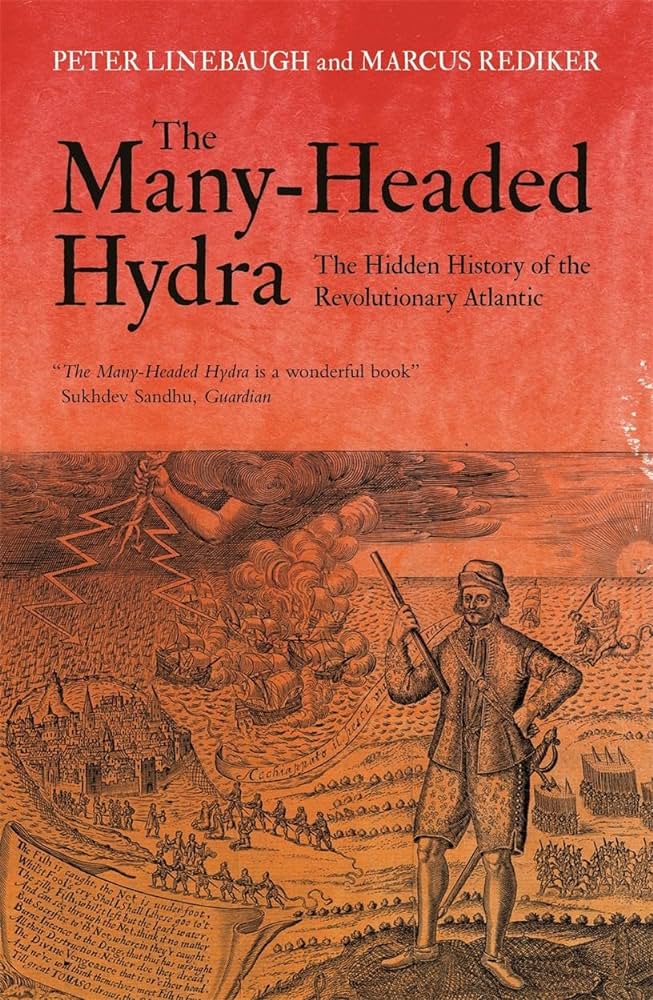
The towering philosopher Francis Bacon conceptualised in 1622 the ‘monstrosity’ of rebellious peoples within the myth of Hercules and the Hydra. Other figures like ex-governor of Suriname J. J. Mauricius when faced with the resistance of the Saramanka maroon communities in 1751, would express their need to stem the ‘Hydra’s growth’. However, the image of an unruly, writhing ‘Many-Headed Hydra’ conjured by authors Linebaugh & Rediker inverts this top-down metaphor of a monstrous threat to civilization.
In these epic tales of desperate and courageous fights to reclaim human dignity on the seas and ports of the Atlantic world, the hydra motif frames ideologies and acts of resistance to enslavement and oppression as heroic heads continually cut down only to be found defiantly respawning. The heads were truly many, and truly varied, from antinomian prophets like Anne Hutchinson who refused to go to war with the Native-American Pequots, to the conspiracies of Edward and Catherine Despard whose conceptions of liberty were inspired by the “highest ideas of freedom” of the Mosquito Indians, and the 1741 New York Conspiracy insurrection predicated on West African military knowledge.
Despite my love for this book, it must be said however that in taking a decidedly neo-Marxist approach in such a broad sweep of Atlantic cultures and societies in the early modern era, Linebaugh and Rediker at times oversimplify the lived experiences of Africans and Indigenous American peoples. In privileging European libertarian narratives over a genuine ethnographic excavation one can make anachronistic assumptions about what resistance really meant for those peoples with distinct and historically specific worldviews. See further reading below to explore this debate.
Alas, putting aside this intellectual jousting match, the Many-Headed Hydra remains a phenomenal resource for scholars and students of the slave trade, labour history, Atlantic history and social history from below. It’s a thought-provoking read for those interested in how today’s configurations of capitalism, democracy and liberty were influenced by the often disregarded ‘hewers of wood and drawers of water’. Linebaugh and Rediker demonstrate how these labourers, slaves and sailors pioneered democratic, multi-racial and transnational connections prior to universal sufferage or modern human rights many of us take for granted. Moreover, they achieved this under conditions most of us couldn’t imagine. Who knows, maybe we can spot the heads of that same Hydra today…
Further Reading
- Fighting the Slave Trade (2003) – edited by Sylviane A. Diouf
- Recreating Africa (2003) – by James Sweet
- West African Warfare in Bahia and Cuba (2014) – by Manuel Barcia
- The Making of the English Working Class (1963) – by E. P. Thompson
- The Common Wind (2018) – by Julius S. Scott
 WallerWrites - History, Music, Politics & Culture
Leave a comment