“…to call it hyper-capitalism, or platform capitalism, or rentier capitalism – would be not just a failure of the imagination but to miss the great transformation of our society that is currently taking place… the triumph of rent over profit.” – Yanis Varoufakis
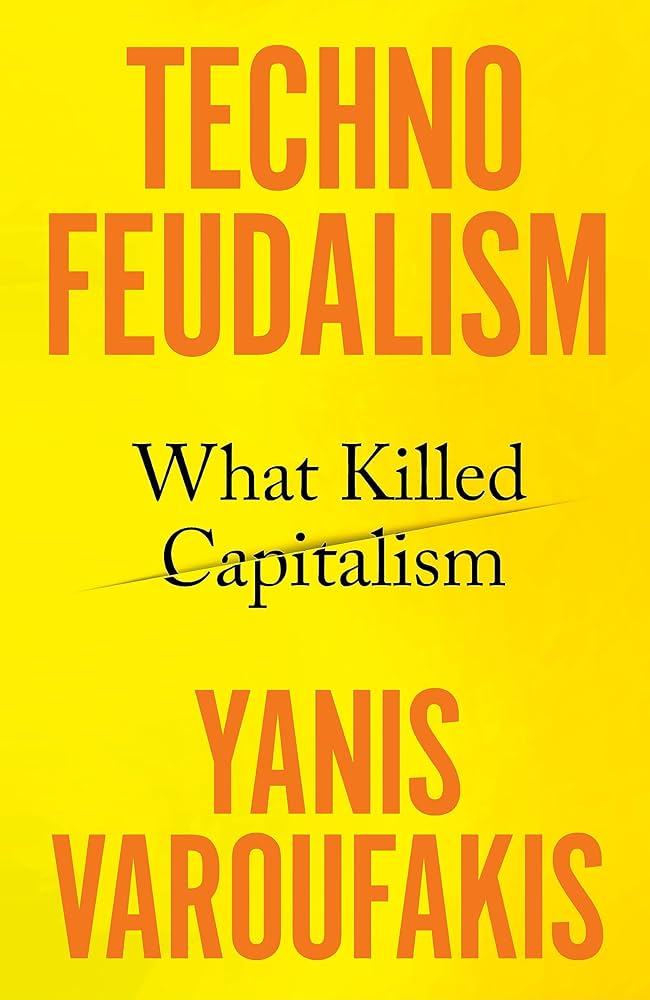
Every now and then a book will come along that encourages a fundamental change of thinking. This was my experience when I picked up Technofeudalism a few weeks ago. I’ve had two spine-tingling hunches in recent years, firstly, that the focus of my leisure-time has changed rapidly and I’m not sure quite how or why? And secondly, that the traditional left-right politics I was familiarised with seem increasingly incapable of addressing our current societies and their predicaments from impending climate catastrophe to the so-called ‘culture wars’. I’ll explain later how Yanis Varoufakis’ new book has helped me to better unpick these existential hunches of mine, but first, let’s get to grips with Technofeudalism…
With the help of ancient Greek myth and modern series Mad Men, Varoufakis elucidates the inner-workings of capitalism and lays out a history of its transformations in an accessible way; engaging for the laymen (that’ll be me) and professional economist alike. Written in the form of a letter to his father, Varoufakis argues that capitalism has evolved out of itself; turbocharged by technological developments which have resulted not in Karl Marx’s dream of socialism but something that more closely resembles the feudal world Adam Smith had announced dead in 1776 when he published the Wealth of Nations.
Varoufakis places his analysis of where we are now in the context of capitalisms post-war journey in the second half of the 20th Century, from the Bretton Woods technostructure to the rise of the Global Minotour (see further reading below) culminating in the 2008 financial crash. Since the crash it’s been difficult to plot where we are economically and politically with ever-evolving global chaos; The Euro-Crisis, Brexit, Trump, A US-China Cold War, Ukraine, Israel-Palestine, you name it. Furthermore, with the certainties of western social democracies and financialised capitalism in disarray post-2008, we’re left in some kind of no-man’s land. According to Varoufakis however, right under our noses a seismic shift in our world has taken place. The shift from Capitalism to Technofeudalism.
If capitalism can be defined as a system whereby our economies are governed by the twin-pillars of markets and profits, Technofeudalism can be defined as a reality within which rents dominate. The owners of ‘cloud capital’ extract rents (Amazon charges companies 40 per cent of their profits as a ground rent for using the platform!) from their vassals and the serfs (that’ll be us) produce the value by working for free providing our data. Varoufakis argues this has major implications for the concept of the liberal individual. ‘Cloudalists’ don’t so much own the means of production but the means of behaviour modification.
Let’s return to the first of my unfortunate hunches. Perhaps you share it? I myself have found my viewing habits modified considerably through over-exposure to sites like YouTube. Technofeudalism makes clear the connection between Google’s algorithm, which Varoufakis tells me knows me better than I know myself, and my changing activities in my leisure time, or should I say, during my hours as a cloud serf. This dystopian description may be somewhat exaggerated, but the extremity of this diagnosis is a helpful wake-up call for all of us as we navigate through our online activity. Our data, our online habits, are highly valuable and at the same time highly influenced, a vicious cycle that Varoufakis illuminates when describing the relationship between Alexa and its customer, “it is training us to train it to train us to train it…”
I will however temper my praise of Technofeudalism by saying that for a book which is making such a bold claim about a great transformation in our global economy and societies, it features worryingly sparse data. In making such profound claims I felt unsatisfied by a small amount of empirical evidence in the main text or footnotes for that matter. The book consists mostly of analysis and rhetoric which Varoufakis has seemed to decide unnecessary to evidence explicitly.
My second existential worry was that left-right political traditions are not fit for purpose. In the stagnant waters of seemingly ever-polarising politics and cultural fragmentations, consensus of any kind in our societies seems to be a lost cause. Technofeudalism, however maps out the macro-economic reality within which we all live. Could a return to broader thinking of this kind revive values of shared humanity and a progressive politics beyond national and cultural distinctions? Varoufakis closes the book by fleshing out how this cloud capital can be socialised and democratised, through changes in corporate structure, property rights and much more. The unique strengths of Varoufakis’ arguments are their appeal to traditional leftists and libertarians alike. Whether political projects can be built to materialise Varoufakis’ vision of Another Now, is yet to be seen…
Further Reading
- The Global Minotaur: America, Europe and the Future of the Global Economy (2011) – Yanis Varoufakis
- Doughnut Economics: Seven Ways to Think Like a 21st-Century Economist (2017) – Kate Raworth
- Economics: The Users Guide (2014) – Ha-Joon Chang
- Less is More: How Degrowth Will Save the World (2020) – Jason Hickel
- The End of Certainty: Towards a New Internationalism (2010) – Stephen Chan
 WallerWrites - History, Music, Politics & Culture
Leave a comment