“The most powerful tool in economics is not money, nor even algebra. It is a pencil. Because with a pencil you can redraw the world.” – Kate Raworth
“I can calculate the movement of stars, but not the madness of men” – Isaac Newton
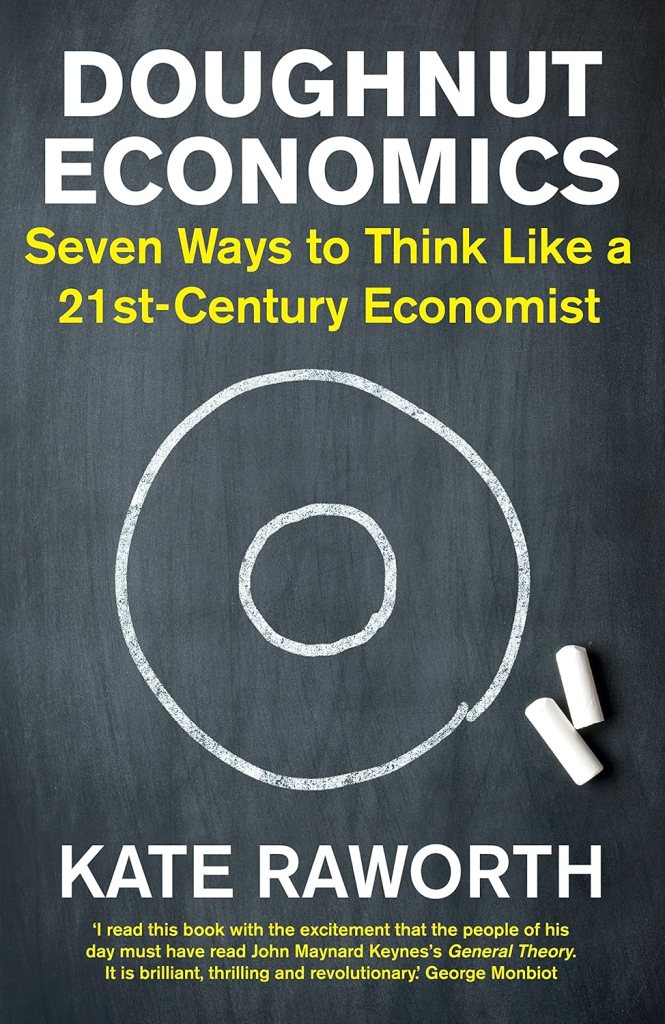
For most people getting their heads around an impending ecological apocalypse is about as appealing as reading an economics textbook. Understandable. Especially when conversations about economics tend to yo-yo between extremes; the patronising economist who insists you’re too uneducated to understand the sophisticated mathematics of an equilibrium model to the bloke down the pub who doesn’t understand why the government won’t just tighten their belts like the rest of us when we’re a bit hard up. As for climate change, one minute we’re debating the wisdom of young activists editing Vincent Van Gogh’s Sunflowers with a brushstroke of Tomato Soup at the National Gallery; the next minute we’re scratching our heads at the brazen climate change denial in the US Republican party.
Time out. Time to put aside the mess that is current climate politics and with it our prejudices about whatever ‘economics’ is supposed to mean. Pick up a pencil and a piece of paper. Draw a small circle. Then another slightly further out. You should have something that resembles a doughnut with a hole in the middle, the kind you might come across at a fun-fair, festival or seaside town.
This simple diagram encapsulates the groundbreaking work of Kate Raworth senior associate at Oxford University’s Environmental Change Institute. Pictures, phrases and concepts are fundamental to how we conceive of the world. Drawing on research in behaviorual economics, psychology and anthropology Raworth explains how dangerous ideas about the ‘natural laws’ of economics have embedded themselves in our thinking under our very noses. Take the concept of ‘economic growth’. Growth is good right. Grow up, improve, develop, progress, get better, cheer up! A susceptible logic that has precluded us from recognising that the widespread obsession nations have with increased rates of GDP growth year on year is insanity pure and simple. As David Attenborough put it, “Anyone who thinks you can have infinite growth in a finite environment is either a madman or an economist.”
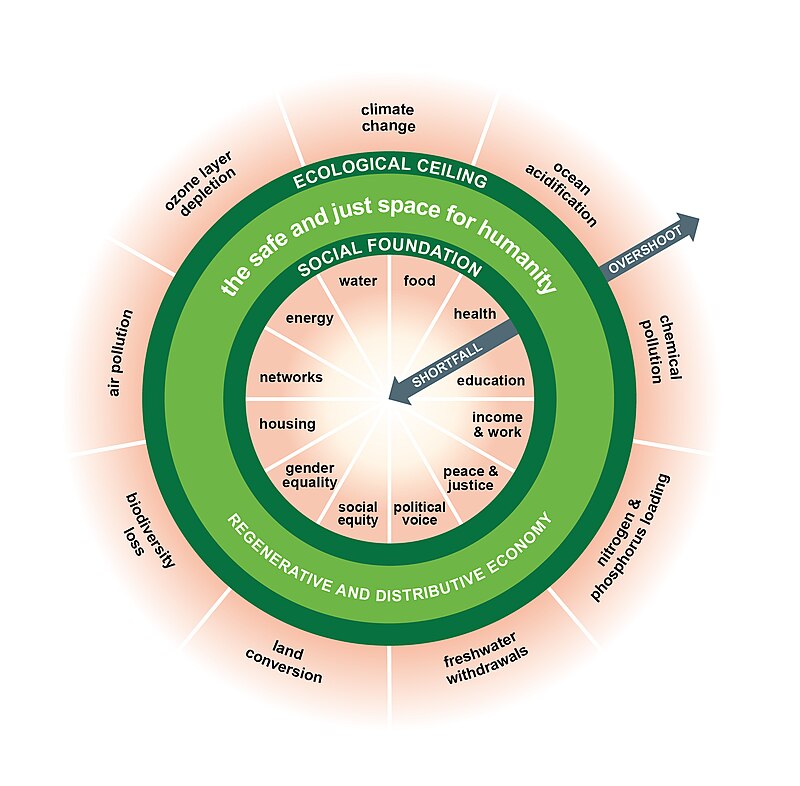
But what’s this dubious doughnut sketch got to do with economics and the climate crisis? Well, this tasty innovation reframes our thinking as a global community. The doughnut encourages us to move from the conventional wisdom of perpetual consumption and deepening inequality to a world of social and ecological justice where humanity learns to thrive and find balance. We need our global community to find its way into the sweet spot of the doughnut with access to food, water, education and the freedoms to thrive in dignity in life, a safe and just space for humanity. At the same time Raworth’s doughnut tells us that we cannot overshoot these planetary boundaries and jeopordise the health of the planet we call home.
Of course, reading this book in the context of where our politics stand today, in the midst of such volatility, polarisation and economic hardship, one is left with little hope that the lofty ideals of the doughnut will be adopted by the worlds’ major powers whose action is needed most. This is where Raworths Doughnut Economics Action Lab initiative is fundamental; bringing together the stories of politicians, teachers, business people, community leaders putting the ‘doughnut’ into action. From Stockholm to KwaZulu-Natal, from Bhutan to Australia, interest has been sparked at this fundamental rethinking of our economic and social future. Case by case the overton window of acceptable ideals may be shifted to a place where ecological and social justice is no longer a pipe dream.
Further Reading
- The Case for the Green New Deal (2019) – Ann Pettifor
- Regenesis: Feeding the World Without Devouring The Planet (2022) – George Monbiot
- Less is More: How Degrowth Will Save the World (2020) – Jason Hickel
- Edible Economics: A Hungry Economist Explains the World (2022) – Ha Joon Chang
- Talking To My Daughter About The Economy (2013) – Yanis Varoufakis
 WallerWrites - History, Music, Politics & Culture
Leave a comment